// 1 July 2026
Your customers are on one bar of signal. A slow website loses them.
We obsess over Lighthouse scores, but to someone standing outside your café on a patchy Dartmoor lane, or reading between Tube stations, speed is simpler than that — the page either loads before they give up, or it doesn't. What the research actually says about how many you lose, and why a static site is the fix.
- · performance
- · static sites
- · business
- · local seo
Every website performance article opens the same way: a screenshot of a Lighthouse score, a big green 100, a note about Core Web Vitals. I have one of those on my own services page. And I understand why it leaves most business owners cold. A performance score of 100 is about as motivating as being told your car passed its MOT — good to know, but so what.
So let me put it a different way, because the “so what” is the whole point.
The moment you actually lose someone
It’s a Saturday in August. Someone is driving down through Devon on the A38, kids in the back, and they’ve decided they want lunch. They pull off, and somewhere near Ashburton on a lane with one bar of signal they search “dog friendly pub near me”. Three results come up. They tap the first. It’s a WordPress site with a big header image, a cookie banner, a chat widget and eleven plugins, sitting on a shared server two hundred miles away. On full fibre it loads in four seconds. On one bar of 4G, halfway down a valley, it just… spins.
They don’t wait. Nobody waits. They tap the back button and try the second result, which happens to be your competitor’s, and it loads, and that’s where they eat. You were the first result. You still lost the booking. You never even knew they were there.
Now move that same person to London. They’re on the Tube, reading a news article on mobile data between Holborn and Chancery Lane, in that patchy window where the signal comes and goes. The page is heavy. It doesn’t finish loading before the carriage moves and the connection drops. They close the tab. For a publisher, that closed tab is a page view that never counted and an ad impression that never rendered — actual money, gone, at the exact second the reader was interested.
This is what a slow website costs. Not a lower score. A customer who was ready, on the day, in the moment, and went somewhere else.
What the research actually says
I try not to make claims I can’t back up, so here is the data, and it’s more damning than my intuition was.
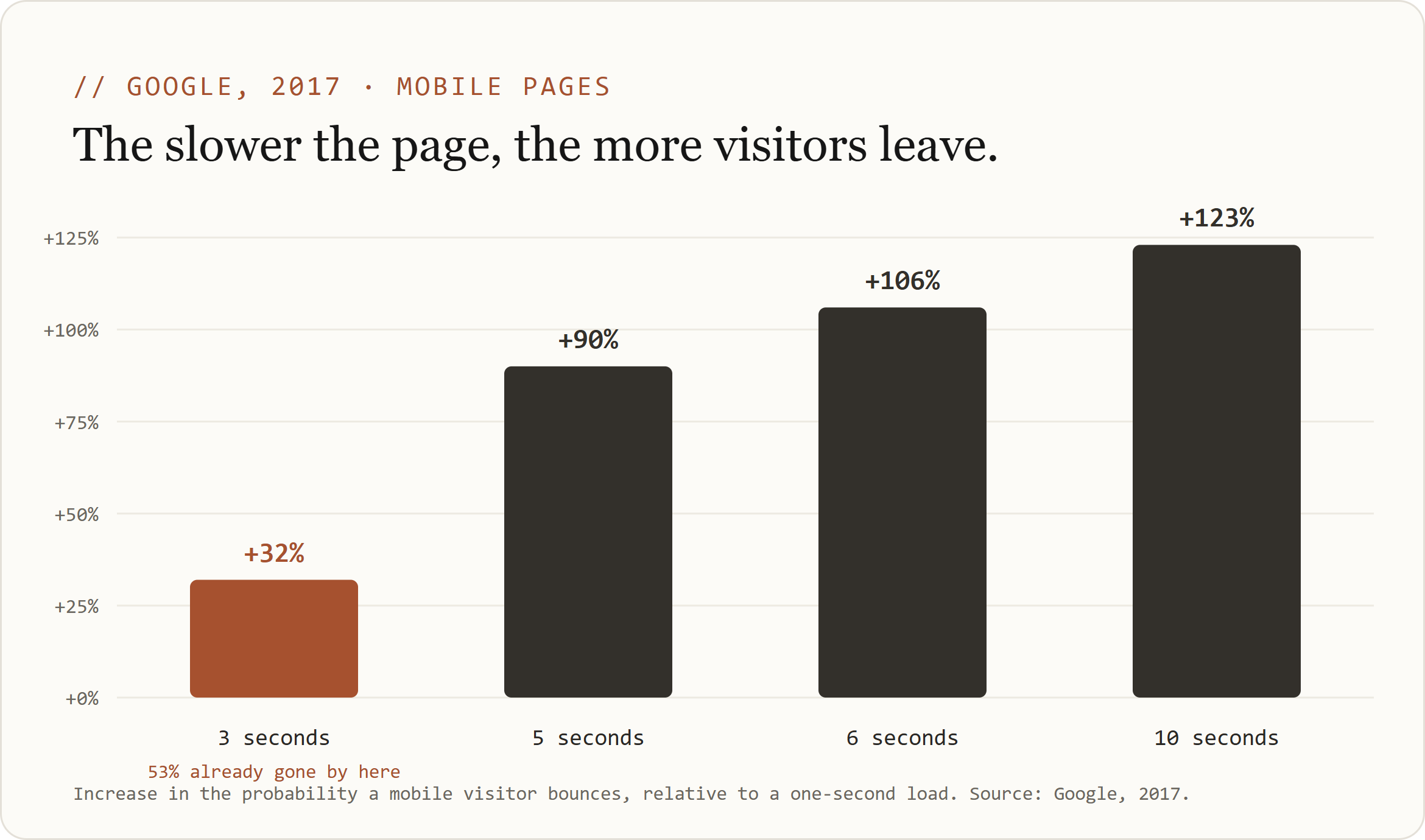
- Google studied over 900,000 mobile pages and found that as load time goes from one second to three, the probability that someone bounces rises by 32%. From one to five seconds, it’s 90%. From one to ten, 123%. (Google, 2017)
- More bluntly: 53% of mobile visits are abandoned if a page takes longer than three seconds to load. Just over half. (Google, 2017)
- The BBC found they lose around 10% of readers for every additional second their pages take to load. At their scale that is an enormous number of people — and it maps exactly onto the commuter-on-the-Tube problem. (BBC engineering, 2018.)
- On the business side, Deloitte’s Milliseconds Make Millions study — 37 brands, over 30 million sessions — found that a 0.1-second improvement in mobile load time lifted retail conversions by 8.4% and travel conversions by 10.1%. A tenth of a second. (Deloitte, 2020)
- And Portent’s analysis found a site that loads in one second converts around three times better than one that loads in five. (Portent, 2019)
These studies are a few years old now, but nothing about human patience has improved since — if anything we’ve all got worse. The direction is not in dispute.
The bit the studies don’t measure
Here’s what those numbers don’t capture, and it’s the part that matters most for where I work.
Every one of those studies measures load time on a normal connection. But load time isn’t a fixed property of a website — it’s a negotiation between the site and the connection it’s being loaded over. A heavy site on good fibre is merely slow. The same heavy site on a weak, intermittent mobile connection isn’t slow — it’s broken. It doesn’t load at all before the person gives up or the signal drops.
And a weak, intermittent mobile connection is not an edge case in my part of the world. It’s the default. Large stretches of Devon, Dartmoor and Cornwall have genuine mobile notspots — Ofcom’s own coverage maps are honest about it. Your customers are not sitting at a desk on fibre when they look you up. They’re in a car park, on a coast path, in a farm shop, on a lane, on the exact patchy signal where a heavy website falls over. The London version of that lane is the Tube.
So the argument I’d make to a business down here isn’t “you want a good performance score.” It’s: the people trying to find you are on the worst connections, at the moment they most want to buy, and a heavy website is the one thing guaranteed to lose them there.
Why a static site actually fixes it
This is not a problem you fix by installing another plugin. It’s a problem you fix by having less to load in the first place, from somewhere closer.
A static site — the kind I build on Astro and Cloudflare — is a folder of pre-built files with no database to query, no server-side code to run, and none of the plugin weight that accumulates on a typical WordPress build. Those files are served from Cloudflare’s edge, which means from a data centre physically near the visitor rather than one server in one place. On a good connection that’s the difference between fast and instant, which nobody notices. On one bar of signal it’s the difference between loading and not — a small payload with few round-trips is exactly what survives a flaky connection, and a heavy dynamic page hitting a distant origin is exactly what doesn’t.
That’s the honest reason speed leads my static-site pitch. Not the score. The score is just the proxy. The real thing is that when someone finds you from a bad signal on the day they’re ready to spend money, your website is the one that still loads — and your competitor’s is the one still spinning.
If you want to know how yours holds up on a real phone on a real connection — not a lab score, the actual thing — get in touch and I’ll take a look.
// thanks for reading
If something here was useful — or wrong — I'd like to hear about it. Email james@willcocks.uk.