// 21 July 2026
Show your work, not someone else's
On a services or product site the photographs do more selling than the words do — and most of the sites I'm asked to fix are selling with someone else's. A note on why stock imagery and obviously-AI pictures quietly cost you trust, how I find real photographs even when a client swears they have none, and the narrow places AI genuinely earns its keep.
- · photography
- · branding
- · business
- · ai
I can spend a long time on the words on a website. I care about them. But if I am honest about what actually moves someone from “browsing” to “getting in touch,” it is rarely the paragraph I laboured over. It is the pictures. On a site that sells a service or a product — which is very nearly every site I build — the photographs do more selling than the copy does, and they do it in the first second, before a word has been read.
So it is worth saying plainly: your images are the single most important thing on your website. Everything else is supporting them.
The photo is the product
If you sell a physical product, this is obvious the moment you see it done well. Good product photography does not just show the thing — it shows that you care about the thing. Consistent lighting, the same clean background on every shot, the same angle and crop. When a range of products is photographed to a single standard, the whole page reads as considered, and that read transfers straight onto the business.
The tell is when one photo breaks the set. Nine crisp, evenly-lit shots and one that was clearly taken on a phone under a kitchen light — that odd one out does more damage than a missing photo would. It stands out precisely because everything around it was done properly. Uniformity is not fussiness; it is the thing that makes the whole gallery feel like it belongs to one professional operation.
This is not just my opinion, either. In a 2025 survey of UK shoppers, 87% said visuals were the single most important factor in a purchase decision, and 63% said inconsistent product imagery made a seller look unreliable. The photographs are not decoration on top of the pitch. On a lot of sites they are the pitch.
The same logic holds for services, it is just less literal. A builder, a plasterer, a gardener, a photographer — their “product” is the finished job. Photographs of real finished work are the entire proof. Which is why the substitutes are such a problem.
Stock photography is someone else’s product
I open a lot of existing sites in the course of quoting for a rebuild, and a huge proportion of them are selling with stock imagery. The smiling headset call-centre woman. The four diverse colleagues pointing at a laptop. The generic “roofing” photo of a roof that is not one your client has ever touched.
Stock has its place — an abstract concept, a background, an illustration of an idea you cannot photograph. But for a business whose whole pitch is the quality of what we make or do, stock imagery is quietly corrosive, for two reasons.
The first is that it shows someone else’s work. A stock roof is not your roof. A stock kitchen is not a kitchen you fitted. The one thing a prospect actually wants — evidence that you do good work — is the one thing a stock photo structurally cannot provide. It is a picture of the absence of proof.
The second is subtler and, I think, more expensive. Plenty of visitors will not consciously notice. It registers as a vague note of this business could not show me the real thing, and that note lands quietly on professionalism.
But here is the part worth sitting with: the people who do notice are the people who know your trade. And that is not an even spread of your audience — it is concentrated among exactly the visitors you can least afford to lose. The knowledgeable customer. The trade buyer. The chef comparing suppliers. The person spending the most money and asking the hardest questions. They do not vaguely sense something is off; they can see precisely what is wrong, and once they have seen it they read everything else on the page with a raised eyebrow.
Take roofing. Search for a stock “roof” photo and a great many results show asphalt shingles — the North American default. British roofs are overwhelmingly not that: concrete tile (58%), clay (16%) and slate (15%) account for the vast majority, and shingle over here turns up mostly on sheds and garages. So a UK roofer whose homepage leads with a shingle roof is advertising a roof they would almost certainly never fit. Most visitors will scroll past it. Every roofer, every builder, every surveyor and every homeowner who has recently had a roof done will clock it instantly — and what they clock is not “nice photo,” it is this person does not know their own trade. Which is a brutal thing for a photograph to say about you when it isn’t even true.
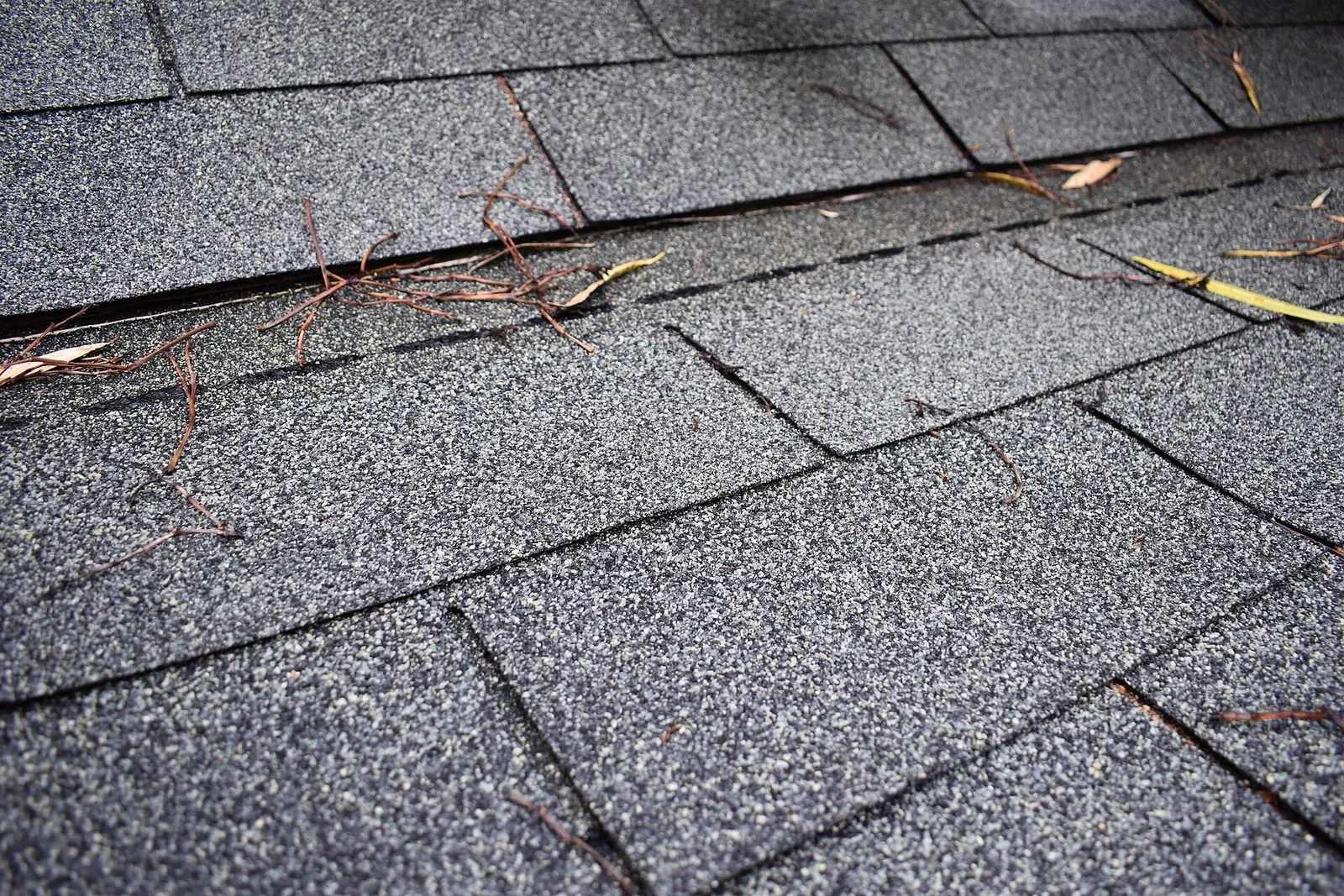
This is an asphalt shingle roof — the sort of thing a stock “roofing” search hands you, and a roof you will almost never see on a British house. Photo: FASTILY · CC BY-SA 4.0. And yes, the irony is noted: a stock photo, used to illustrate an idea rather than to stand in for my own work. That is exactly the line.
I ran into the same thing from the other direction while sourcing imagery for a Dartmoor beef and lamb producer. I went looking at the food suppliers further along the chain, and found post after promotional post about named farms and specific provenance — the exact language premium food is sold on — illustrated with generic stock shots of the cut in question. The same photograph, in several cases, that a dozen unrelated sellers were also using. The copy promises you provenance; the picture has none. For a business whose entire proposition is we know precisely where this came from, that is a small self-inflicted wound, and any chef who has seen the same image on three other supplier sites has already drawn a conclusion.
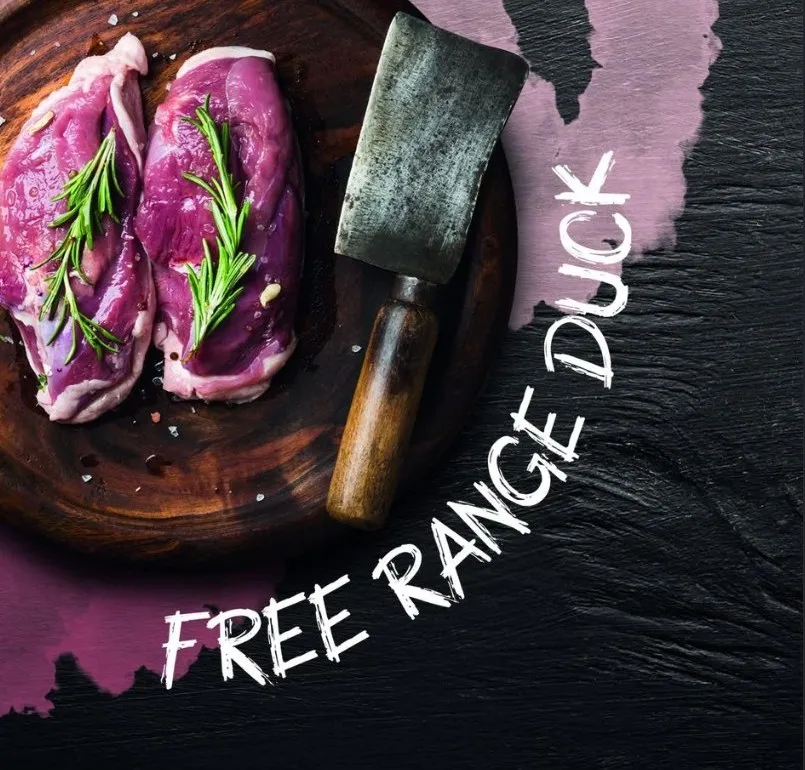
The post. Brand colours, hand-lettered type, a properly art-directed look — real effort has gone into this. Supplier name, farm name and phone number cropped away.

And the words beside it. Everything specific — the supplier, the farm, the phone number — is removed, because the point is a widespread habit rather than one business. What is left is the pitch: flavour, quality and provenance.
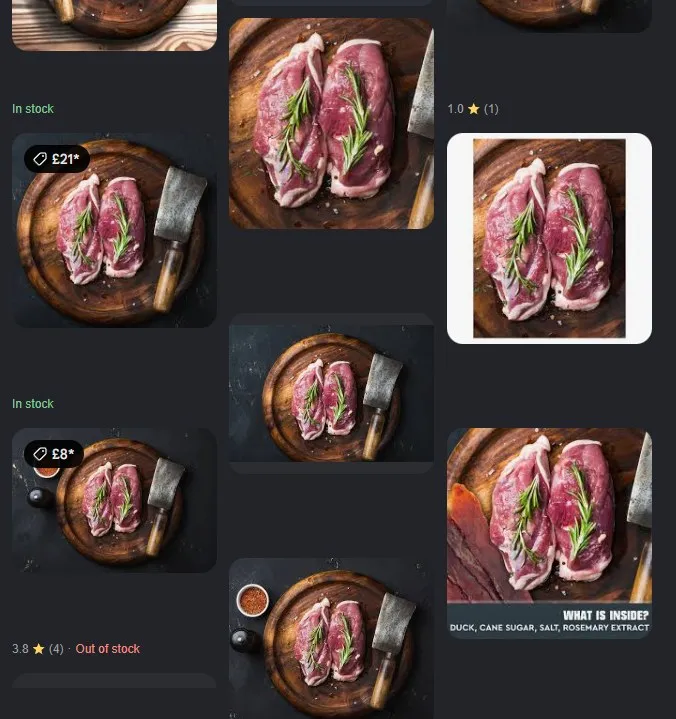
And the photograph underneath it all — the same shot, in a single search, across nine unrelated sellers: butchers, wholesalers, a marketplace listing, a dog-treat brand. Seller names removed. Nobody in that grid is showing you their duck.
So I am not saying never use stock. I am saying use it with your eyes open — know what the photo is actually showing, and never let it stand in for the thing you are selling. At the higher end of any market that carelessness is close to disqualifying. Nobody chooses the premium option from the business that furnished its own website with clip art.
Where the real photos actually are
Here is the honest snag, and it is the reason so many good businesses end up with stock in the first place: getting real photographs out of a client is genuinely hard. I ask trades for pictures of their work and the answer, more often than not, is a vague promise and then silence. Not because the work does not exist — because it is scattered, un-backed-up, on an old phone, or simply because photographing finished jobs is nobody’s priority when there is a next job to get to.
But the photographs frequently do exist. They are just not where I first look. They are on Facebook — and, increasingly, Instagram.
A tradesperson who is proud of their work very often has an active Facebook or Instagram page full of it — before-and-afters, finished jobs, the occasional genuinely great shot — posted over years because that is where the local eyes are. It is a real body of work. It is just sitting on a platform that is not a website and never will be.
So this has become a standard part of my workflow: I pull the publicly available photos straight from a client’s Facebook and Instagram pages. I use a tool called Apify to extract every public image in one pass, and then I sit down and curate — throw out the blurry ones, the duplicates, the low-resolution reposts, and keep the shots that actually show the work at its best. What comes back is very often more than enough real imagery to build an entire site around, sourced from the one place the client was already documenting everything.
It has quietly changed which businesses I take on. A client who already has an active social presence, a back-catalogue of their own work, and a handful of good reviews is a client who has most of the raw material already — they just do not have it assembled into something that does them justice.
The website makes it official
Which leads to a point worth making on its own. For a lot of these businesses, the website is not really about discoverability. They are already being found — on Facebook, by word of mouth, in the local groups. What the website adds is legitimacy.
A Facebook page is a great start and a genuine shop window, but it is rented ground, and on some level everyone knows it. A proper website — a real domain, a considered design, the work laid out cleanly, the reviews gathered in one place — carries a level of trust that a social profile does not. It says this is a real, settled business that intends to be here next year. Put a formal site on top of an existing Facebook reputation, back it with the real photographs and the real reviews, and you have taken something that was already working and made it official. That is a large part of what people are actually buying when they commission a site from me.
The AI question
Which brings me to the awkward one, because you cannot write about images in 2026 without addressing it. Can you not just generate the pictures?
My answer, for now, is mostly no — and I want to be precise about why, because it is not a blanket objection.
We are in a phase — and I fully expect this to shift — where imagery that reads as obviously AI actively costs a brand trust. You know the look: the too-glossy, slightly-uncanny, faintly cartoonish generated image; the “ChatGPT poster” style that has become genuinely everywhere; the AI avatar standing in for a real person or a real product. Show that to a graphic designer and watch them wince — the craft problems are real. But you do not need to be a designer to feel it.
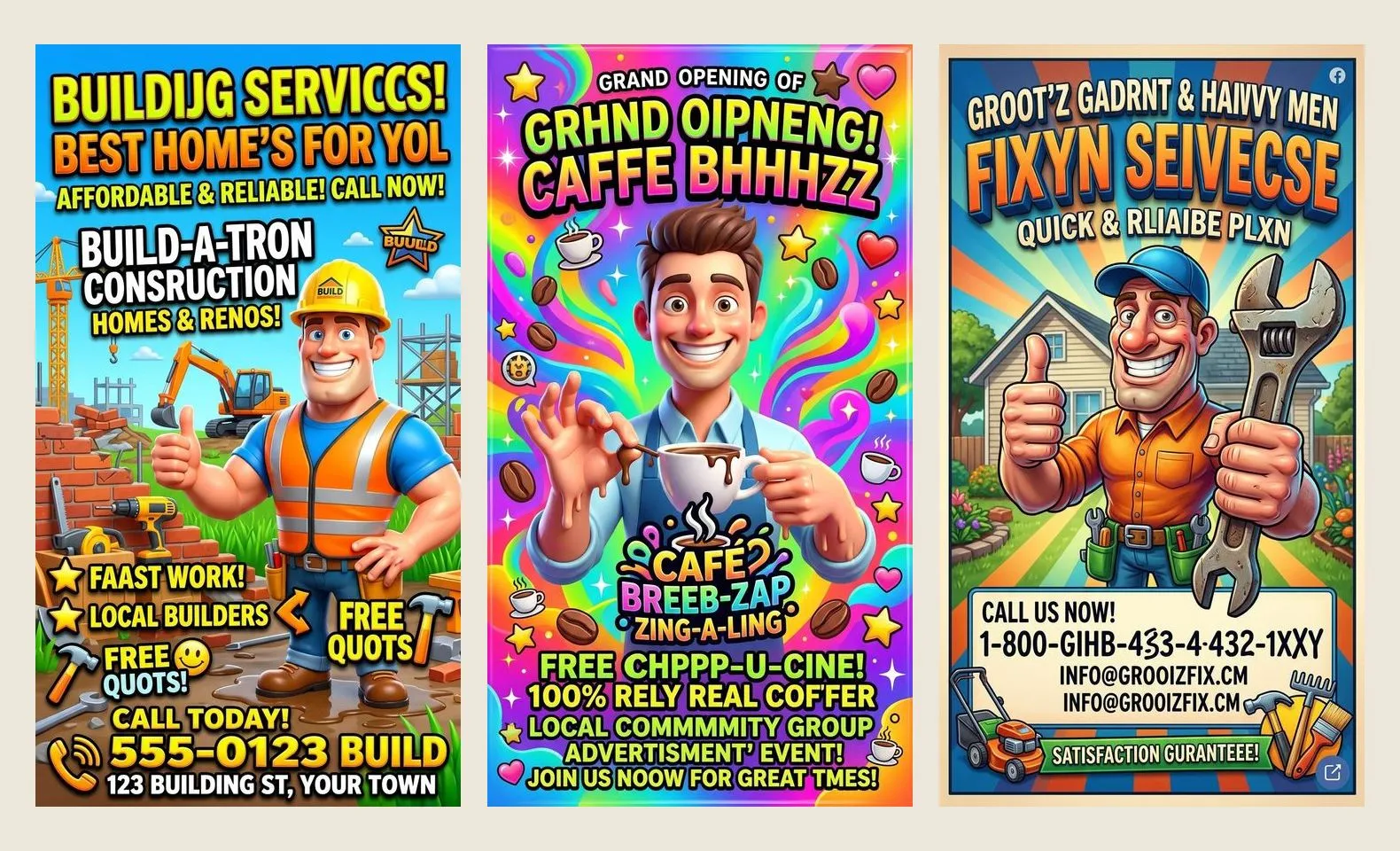
Every one of these is fake — I generated them in a couple of minutes to make the point. But you have scrolled past their real cousins in a local community group this week. Look at the text.
A large slice of the audience clocks that look, and clocks it as this business took the shortcut. And the research backs the instinct. In one 2025 analysis only 7% of people said visible AI in marketing made them trust a brand more, while 31% said it made them trust it less — roughly four times more likely to cost trust than build it. Two-thirds say AI-generated ads feel less authentic, or that less effort went into them.
Here is the counter-intuitive part, though, and it is the whole key to using AI well: when people are shown an AI image beside a real one, only about a quarter can reliably tell which is which. So the penalty is not really about identifying AI. It is about the impression of it — that faint uncanny sheen that whispers “shortcut” even when the viewer could not tell you why. The harm is not “AI was used.” The harm is “I can tell, and it is distracting.” That distinction is everything, and it is where the whole second half of this comes from.
It is the same shape as the stock problem, in other words. Most people will not consciously catch it — and the damage is done by the ones who do.
If you are trying to look professional, and especially if you are trying to reach the higher end of a market, that kind of visible, trying-to-be-real AI imagery pulls in exactly the wrong direction. So on the sites I build, I do not use it — no generated “photographs” of work, no generated people, nothing pretending to be real that is not.
Where AI actually earns its place
But that is not the whole story, and I would be a hypocrite to pretend I never touch the stuff, because I do — every week, and it saves my clients real money.
The distinction I draw is between AI as a subject and AI as a material. I never let it be the subject — never the product, never the person, never anything the visitor is meant to read as real. But as a material — texture, surface, a stylistic backdrop, an icon — it is genuinely excellent, and nobody is being misled, because nobody was ever meant to think a background texture was a photograph of anything.
Go back to that trust penalty for a second, because it maps almost perfectly onto this. The damage tracks how much the image makes you notice the AI. A generated photo of a builder trips the alarm because it is trying to be real and not quite managing it — the uncanny valley does the rest. A generated paper texture or a set of line icons never trips it, because it was never pretending: you were not meant to read it as a photograph in the first place, so there is no realism for the eye to catch failing. Push a generated image far enough into deliberate stylisation — an illustration, an engraving, a flat texture — and “is this AI?” stops being a question anyone thinks to ask. Stylisation is the tell’s off-switch. That is the balance: the closer AI creeps to realism, the more it can cost you; the more openly stylised it is, the safer — and occasionally the better — it gets.
Two examples from real client builds. The first is a page background — a plaster surface, generated:

A generated plaster texture, used as a background. It is not pretending to be a photograph of anything, so there is no realism for the eye to catch failing — and on a site for a trade that works with plaster, a plastered wall is rather the point.
The second is a set of service icons:
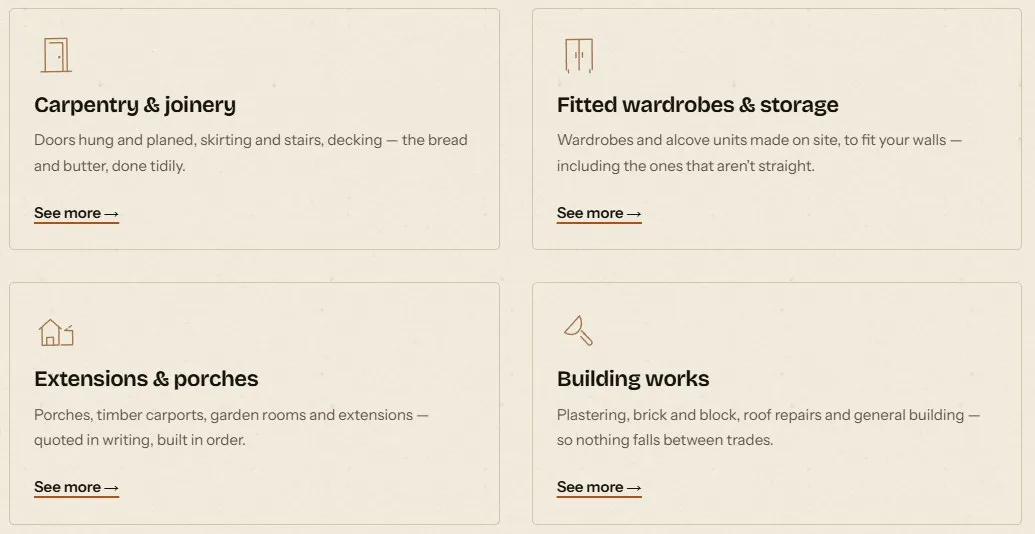
Generated line icons across a services grid: consistent weight, consistent style, drawn to match the site rather than bought off the shelf.
In both cases the work is doing the job a purchased texture pack or icon set would otherwise do, and this is where the practical argument really bites: licensing. A good texture set or icon pack usually means paying for a licence — often an annual one, in perpetuity, for something as small as a background or a set of line icons. Generate it instead and there is no licence to renew, no usage terms to track, no cost beyond the generating. Icons in particular are a case where AI does a clean, useful job without ever tipping into the uncanny.
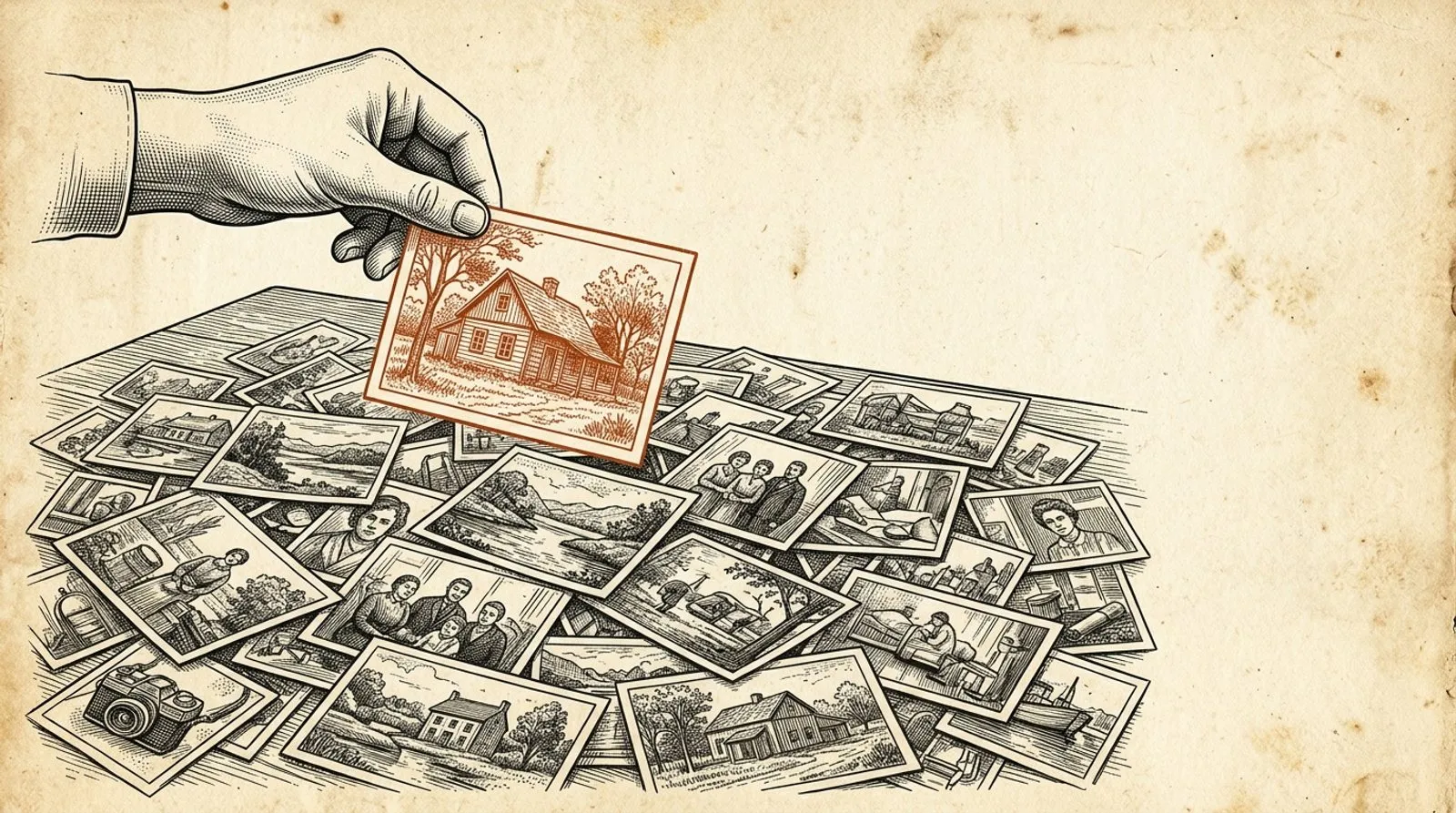
The clearest example is sitting at the top of this very article. I do not have a stock of photographs that would work as headers for these pieces, and I am not going to commission or shoot one for every post I write. So the illustration heading each article is generated — a single vintage-engraving style, aged paper, ink linework, one terracotta accent, held consistent across the whole set. That consistency is exactly the thing AI is quietly excellent at: not realism, not passing anything off as a photograph, but holding a distinct stylistic theme steady across a body of work. It is decoration, doing an honest job, and I will happily tell you to your face that I made it with AI — which is rather the whole test. If I would not admit it, it would not be on the site.
For what it is worth, I generate these with Google’s Nano Banana rather than the ChatGPT image tools, because the quality is a visible step up and — not coincidentally — it steers clear of exactly the house-style tell I described earlier. The one that gives itself away in a crowd. When a job genuinely demands photographic realism there are higher-end tools again, but that is a different job from the one a background texture or an article header is ever asked to do.
So the rule I work to is not “AI good” or “AI bad.” It is: use it where authenticity is not the promise, and never where it is. A texture is not claiming to be anything. A photograph of your work is claiming to be your work — and that claim has to be true, or the whole site quietly stops working.
How I actually do it
When I take on a site, the imagery is one of the first conversations, not the last. I would rather spend an afternoon curating a client’s real photographs — from their phone, their old site, and yes, their Facebook and Instagram — than fill the gaps with stock and hope nobody notices. If the photography genuinely is not there, the honest answer is to go and make some: I will happily fold a photographer or videographer into the quote, because a day of real photography is very often the highest-return money spent on the whole project.
And where AI can quietly carry a texture or an icon and save a licence fee, I will use it, without apology and without pretending it is anything it is not.
The through-line is simple enough. A website’s job is to prove you are worth choosing. You cannot prove that with someone else’s work, and right now you cannot prove it with a machine’s. Show your own.
// thanks for reading
If something here was useful — or wrong — I'd like to hear about it. Email james@willcocks.uk.