// 9 October 2026 · by James Willcocks
Facebook shows the work you get. Your website shows the work you want.
A Facebook page fills up with whatever you did this week, which is usually the work that's easiest to come by. A website lets you choose what goes front and centre, the big job, the specialism, the direction you want the business to grow, and it stays there. Why a small business needs both, and how to run them together without doubling the work.
- · social media
- · business
- · local seo
In January 2025, James Westlake started work on an old farmhouse near Kingsbridge. It was stone and cob, wrapped in sand-and-cement render that had been trapping water in the walls for decades.
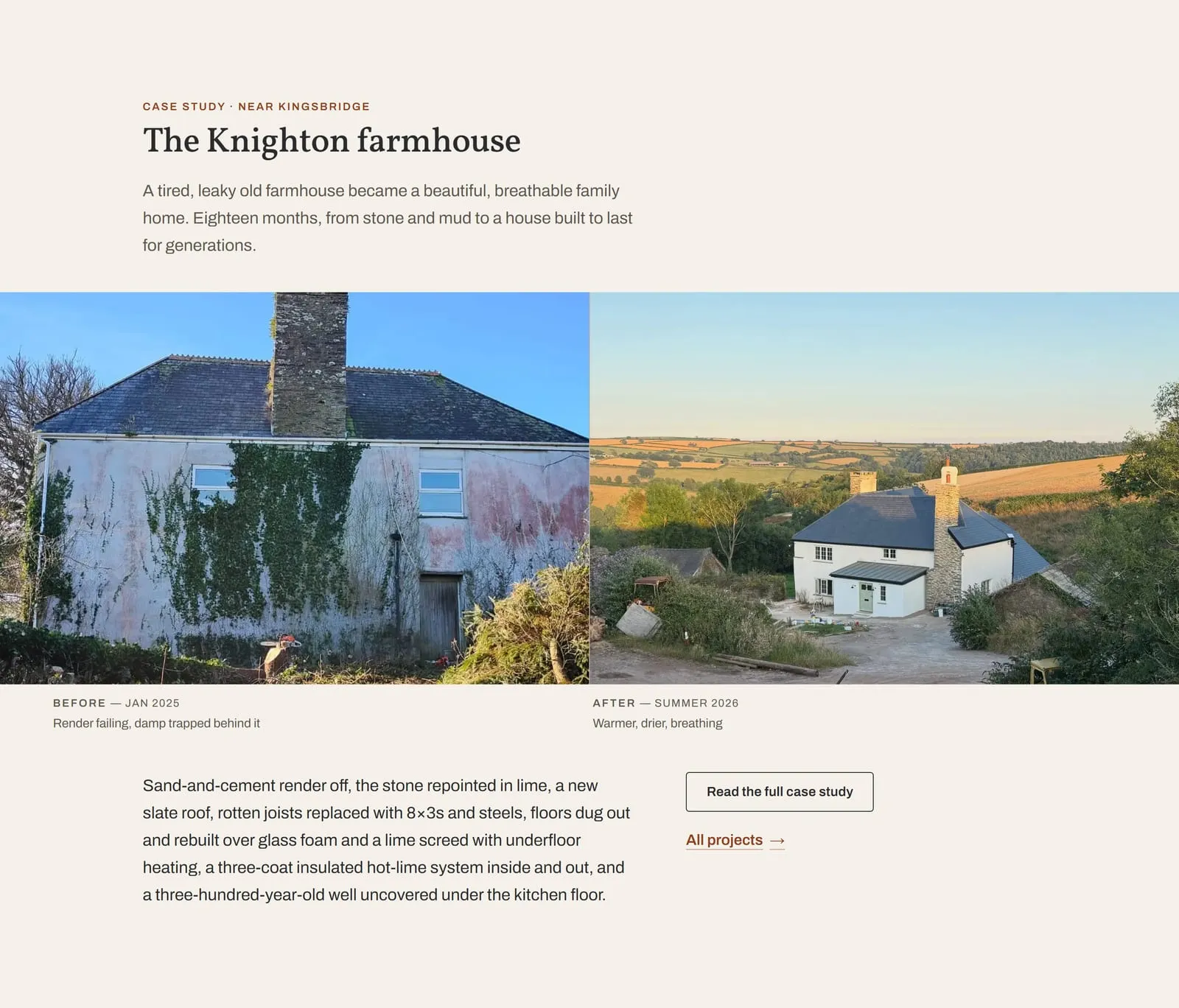
Over the next eighteen months he took it back to the stone and repointed it in lime. He put on a new slate roof and replaced the rotten joists with 8×3s and steels. He dug the floors out and rebuilt them over glass foam and a lime screed with underfloor heating, then finished the whole house, inside and out, in a three-coat insulated hot-lime system. Along the way he found a three-hundred-year-old well under the kitchen floor.
It’s the kind of job that shows every skill a mason has. And if you went looking for it on his Facebook page today, you’d be scrolling for quite a while.
That isn’t because he’s bad at social media. It’s because he’s good at it. He posts his work, and he posts it often, so the farmhouse now sits underneath months of smaller jobs. Every one of them is good work. None of them shows what he can really do.
Your feed shows the work you’re getting
A social media feed runs in date order. Whatever you did this week sits at the top, and everything else sinks.
For most businesses, the work you did this week is the work that’s easiest to come by. It’s the job you get recommended for in the village Facebook group, because it’s the job people have already seen you do. Which is fine, right up until it isn’t the work you want more of.
I’ve worked with electricians who are brilliant at social media. Their feeds are full of rewires, new consumer units and extra sockets in someone’s kitchen, because that’s the work they get. Anyone scrolling past thinks, quite rightly, there’s the person to rewire my house.
But say what you really want is commercial work. Or solar, and home battery systems, because that’s the side of the trade that interests you. A feed full of domestic rewires keeps bringing in more domestic rewires. It shows the business you’ve got, and it quietly keeps you there.
Your website shows the work you want
A website doesn’t run in date order. You decide what goes at the top, and it stays there until you change it.
That makes it the one place where you get to steer. I know a car detailer whose business was built on cars and a lot of loyal, repeat customers. The obvious way to grow was to take on staff, and that brings its own headaches: training, turnover, and the risk that someone learns the trade on your time and then sets up on their own, taking customers with them. So they looked at a different market instead: boats and yachts.
On social media, that move is almost invisible. One yacht in among the cars is just another post, and by next month it’s gone. On a website, one yacht can lead the homepage. The car work is still there, with its own page, for the regulars. But someone searching for yacht detailing lands on a page about yachts, with photos of a yacht, from someone who has done one.
That’s the difference in a sentence. A website can aim at the customers you want. Social media can only show the jobs you’re doing. You need both, and it helps to know which is which.
My own site works the same way. A lot of my work over the years has been for agencies, and I’m always glad to hear from them. But the work I want more of is websites for local businesses, so that’s what my homepage leads with.
Big jobs don’t sink
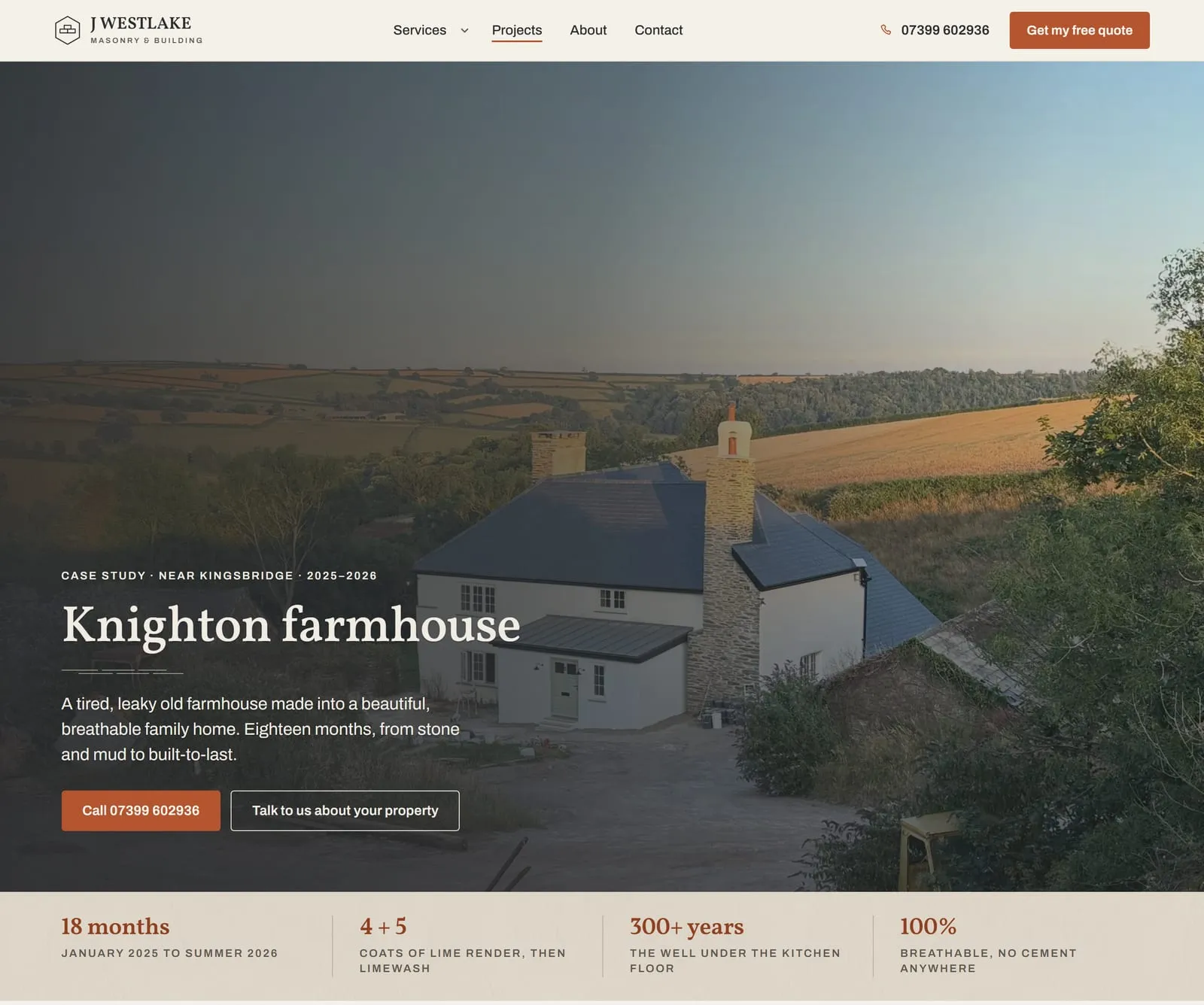
Back to the farmhouse. When I built a draft website for J Westlake Masonry, that job went front and centre. It’s the photo across the top of the homepage, and it gets its own band further down, before and after, with the whole job in one paragraph. (The site is a draft and isn’t live yet, so these screenshots are from my preview of it.)
It also has a page of its own, which tells the story month by month: the strip-out, the scaffold going up, the roof going on slate by slate, four coats of lime render and five of limewash, the well. It’s a long page, and it should be. Someone deciding whether to trust a builder with an old stone house will read every word of it.
Here’s the worry people have about that, and it’s a fair one. If the homepage leads with an eighteen-month restoration, will someone with a garden wall that needs repointing think you’re too big for them?
Not if the site’s built properly. The same homepage splits the services in two: the heritage and lime work he’s known for and wants more of, and the general building he still does every week. Each one has its own page.
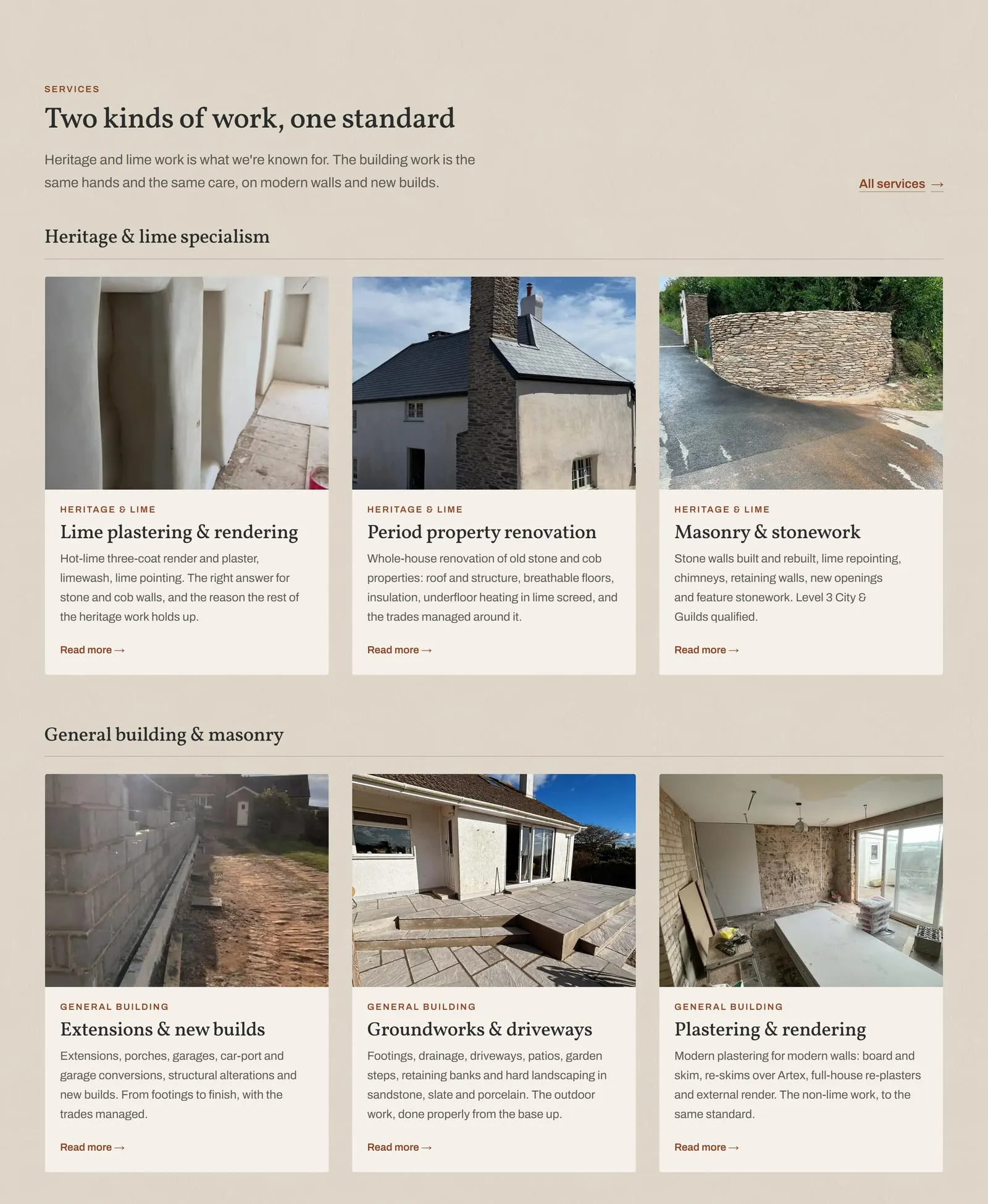
So the person with a big project can see straight away that he handles them, and the person with a garden wall finds a page about garden walls. A feed can’t do both at once. It only ever shows one thing: whatever happened most recently.
What social media is still good at
None of this means deleting your Facebook page. I run one myself, and it does things a website can’t.
Reaching people who weren’t looking. Nobody searches for a cake maker until they need a cake. But a photo of a three-tier wedding cake turns up in a feed, gets shared by the bride’s aunt, and suddenly two hundred people in the next village know your name. Your customers are almost certainly there to see it: Ofcom’s latest figures put Facebook and Messenger in front of 93% of UK adults who use the internet.
Word of mouth, in public. Local Facebook groups are the village noticeboard now. Checkatrade’s own research found word of mouth was the most common way people found a tradesperson, and a local group is word of mouth with the volume turned up.
Proof of life. A post from last Tuesday tells a customer you’re open, busy and still trading, without anyone having to update anything.
Conversation. Quick questions, messages, a thumbs-up on a job well done. It’s the friendliest way for a customer to get in touch, and it takes thirty seconds from the van.
What a feed can’t do
It isn’t yours
Facebook and Instagram are someone else’s building, and you’re a tenant with no lease. The rules change when the landlord decides, and when something goes wrong there’s nobody to ring.
That’s not a hypothetical. A bakery in Wivenhoe, in Essex, was locked out of its Facebook, Instagram and Messenger accounts all at once, and its online orders fell by 42%. The owner kept going through her own website, a newsletter and WhatsApp. She’s far from alone: more than 500 people contacted the BBC in 2025 after Meta disabled their accounts, businesses among them, and Meta’s own support for locked accounts is now led by an AI assistant.
If your page is the business’s only home online, a lockout takes the shop front with it, along with every review and every photo of every job. A website on your own domain is yours. The address is yours, the words are yours, and if you ever fall out with whoever hosts it, you take it somewhere else.
Most of your followers won’t see the post
Building up followers feels like building an audience, and in a sense it is. But the feed decides who sees each post, not you. Socialinsider’s analysis of brand posts puts the average reach of a Facebook post at somewhere around 1 to 4% of a page’s followers.
On a page with a thousand followers, that’s somewhere between ten and forty people seeing any one post. Fine for a photo of a finished job. Much less fine for the one post that says you’re closed for a fortnight.
A feed is a terrible place to keep facts
Your prices, your opening hours, the area you cover, the jobs you don’t take on. On a Facebook page, those are scattered through three years of posts, somewhere underneath a photo of the dog.
Someone checking you out wants answers in ten seconds. A website puts them on the first screen, in plain words, in the same place every time.
The same goes for AI assistants, which more and more people now ask for recommendations: in BrightLocal’s 2026 survey of American consumers, 45% had used AI tools for local recommendations, up from 6% in its previous survey. Those assistants can read public Facebook pages. What they find there is mostly a stream of photos with very little plain description of what you do and where. A website gives them a straight answer to repeat, and I’ve written about why that matters.
Search goes to websites
When someone types “builder Kingsbridge” into Google, what comes back is the map, with its Google Business Profiles, and then the web results. Google says how prominent a business is on that map depends partly on “how many websites link to your business and how many reviews you have”. Those links, from a supplier’s list of recommended trades or the parish website, need somewhere worth pointing at, and a website is the natural place for them to land.
Your Business Profile has a box for your website. Google used to offer free websites built inside the profile itself, then switched them off in 2024, and their addresses stopped working that June. Leave the box pointing at a Facebook page and you’re sending the most interested person of the day back into a feed.
People finish checking you out on your website
In BrightLocal’s 2026 survey, 54% of people went to a business’s website after reading good reviews of it, against 24% who went to its social media.
That survey is American, and I’d be surprised if Devon were very different. The recommendation happens on social media. The decision happens on the website. It’s not that a Facebook page looks bad. It’s that a proper website looks like a business that’s planning to be around, and when someone’s about to let you into their house, that matters.
How to run them together
The good news is that none of this is twice the work. It’s putting each kind of thing in the right place.
1. Facts on the website, life on social. Prices, services, areas, opening hours and how to book belong on the website. Today’s job, this week’s offer and the new van belong on social.
2. Lead with the work you want, not the work you get. Put the job you want more of at the top of your homepage, even if you’ve only done it once. One good set of photos of one yacht, one battery install or one restoration is enough to start.
3. When a big job finishes, give it a page. Before the last photo goes on Facebook, write the job up on your website: what it was, what you did, the before and after. The post sinks within days. The page keeps working for years. Often the best job you’ve ever done is already sitting in your feed, eighteen months down. It just needs taking out and giving a page of its own.
4. Answer questions with a link. When someone comments “how much for a new consumer unit?”, answer it, then add the link to the page that explains it. You’ll stop typing the same reply forty times a year, and they’ll see everything else you do while they’re there.
5. Link both ways. Your website address goes in the Facebook “About” section, your Instagram bio and your Google Business Profile. Your social links go in the website footer, so anyone checking you out can see you’re busy.
6. Change the website first, then post about it. New Christmas hours? Update the site, then post. If the post gets shared around, everyone who clicks through lands on the right information. On my hosting plan, changes like that come out of the hour a month that’s already included, so it’s an email to me, not an invoice.
7. Don’t paste your Facebook feed into your website. It’s tempting: embed the feed and the site “stays fresh” on its own. In practice it loads a heavy chunk of Facebook’s code, which slows the page down and needs a cookie banner to do properly. Worse, it puts your feed’s problem right back on your website: the newest post leads, whatever it is, and the moment you go quiet for a few months it tells everyone your latest news is from March. Link to your page instead.
If all you’ve got is a Facebook page
That’s a better start than you might think. A page with real photos, a few years of posts and a handful of reviews is most of the raw material a website needs. Real photos of your own work, by the way, beat anything from a stock library.
When I build a free first draft for a business, that’s often exactly where I start: the photos from their page, the services they mention in their posts, the reviews their customers have already left. Then the job they’re proudest of goes at the top. There’s more on why I build the site before anyone asks.
So keep the page, and keep posting. Just give the people who see those posts somewhere to land, and make sure the first thing they see is the work you want more of.
// thanks for reading
If something here was useful, or wrong, I'd like to hear about it. Email Email us.